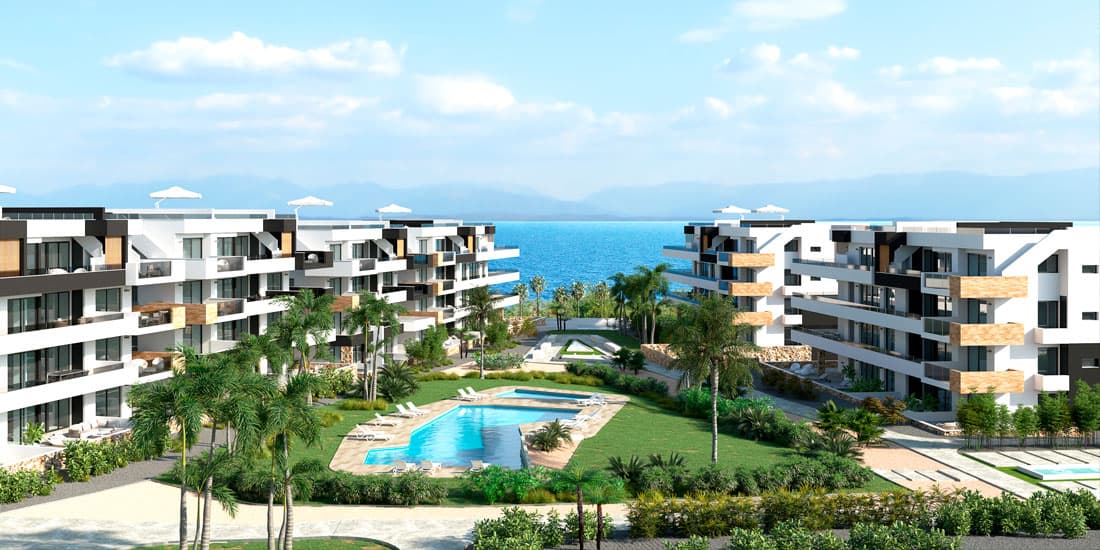
Flats & apartments for sale in Spain

Flats in Spain

Flats and apartments for sale on Costa Blanca and Costa del Sol – new builds in the best locations. Full purchase support for international buyers: from location search to notary completion.
Featured flats & apartments

The latest and most interesting listings in our portfolio

Flats & Apartments in Spain – Buy and Invest by the Sea

Searching for flats in Spain means pursuing two goals at once: a smart euro- denominated investment and a genuine improvement in quality of life. Spain remains one of Europe's strongest property markets – not just for holidays, but for long- term ownership. In 2025 the country welcomed a record 96.8 million tourists, directly boosting rental demand and property values across Spanish real estate.

The Spanish residential market is hyperlocal: prices, taxes, short-let regulations and demand dynamics differ even between neighbouring towns on the same coastline. At Horizon Properties we start with your goal (lifestyle vs. investment), budget and risk tolerance – then identify the right region, town and property type for you.

For international buyers the key safety considerations are: thorough legal due diligence, understanding the true cost of purchase (taxes and fees), the impact of the so-called "valor de referencia" on taxable value, and – if you are considering short-term rentals – compliance with fast-evolving registration requirements.

Why buy a flat in Spain

Buying a flat in Spain can be an emotional decision, but the best outcomes come from a strategic approach: combining lifestyle logic with investment thinking. It is one of the few European markets where the same asset class lets you enjoy private use (holidays, second home) alongside flexible rental income in off-peak months.

Spain's most-cited advantages are climate, infrastructure and quality of life – but for investors the macro factors matter equally. The market operates in euros, giving international buyers currency diversification and reduced concentration risk. In periods of elevated inflation, property is often seen as a store of purchasing power – provided you buy in a location with durable demand and genuine resale liquidity.

If everyday convenience is a priority, consider areas with strong urban infrastructure – hospitals, restaurants, transport links and an international airport – such as the surroundings of Alicante, home to a large international community and year-round amenities.

Are flats in Spain a good investment?

They can be an excellent investment – with the right strategy and realistic assumptions. It helps to separate two return drivers: rental income and capital appreciation over time.

Capital appreciation: Spain recorded strong house price growth in recent quarters. The HPI for Q4 2025 showed annual growth of around 12.9%. The average registered price reached €2,284/m². This supports the case for market liquidity but is not a guarantee of future performance – location and price segment are critical variables.

Rental income: Yields depend on the model (holiday vs. long-term), seasonality and operating costs. Market reports pointed to around 6.7% average gross yield nationally in early 2026. In practice, investors should model net returns after deducting community fees, utilities, insurance, management costs and maintenance reserves.

Key risks and how to mitigate them:

  • Legal risk: purchasing without full verification of charges and restrictions. The standard is to review a nota simple from the Registro de la Propiedad plus all vendor documentation.
  • Tax base risk: the "valor de referencia" can affect the taxable base in many regions, where the tax authority uses the highest of the reference value, declared value or purchase price.
  • Short-let regulatory risk: alongside regional rules, registration obligations and platform requirements are growing rapidly.
  • Over-optimistic assumptions: holiday rental income can look great in season but requires active management, marketing and resilience to demand swings.

Types of flats and apartments in Spain

The search terms "flats in Spain" and "apartments in Spain" cover several distinct product types. Choosing the right one affects your purchase costs, risk profile, taxes and rental potential.

New-build flats (off-plan and new development)

  • Pros: modern energy standards, communal amenities (pool, gym, security), high appeal for short-term rental.
  • Build warranty: a 10-year structural guarantee regime applies to key construction elements (the "seguro decenal" system).
  • Cons: typically higher entry price; tax-wise, VAT (IVA) and stamp duty (AJD) apply instead of ITP.
  • Best for: buyers who want no renovation work, seeking comfort, quality and predictable running costs.

Resale flats

  • Pros: often better location (closer to the centre, beach or amenities), value- add potential through refurbishment, sometimes a lower entry price.
  • Cons: risk of hidden defects, older common areas and higher maintenance costs – rigorous legal and technical due diligence is essential.
  • Investment case: well-suited to buying below potential and building value through modernisation.

Holiday flats (sea-view and beachfront)

  • Pros: high appeal for private use and seasonal letting, especially in regions with consistent tourist demand.
  • Cons: seasonal income and regulatory risk (licences, registries, platform requirements).
  • Best for: buyers combining lifestyle with income, and investors seeking flexibility.

Premium and luxury flats

  • Pros: more stable demand profile in prime locations, prestige, stronger price resilience through the cycle.
  • Cons: higher entry threshold; some regions apply elevated tax rates for properties above €1 million.
  • Investment note: micro-location and specification selection matter enormously – "premium" in Spain varies widely in actual quality.

Best regions to buy a flat in Spain

For international buyers the two first-tier markets are Costa Blanca and Costa del Sol – but they have different price profiles, buyer demographics and rental rhythms. Choose your region using a simple matrix: purpose (use vs. investment), budget, lifestyle preferences and acceptable income variability.

Costa Blanca

  • Profile: broad market, wide price range, towns with year-round life and strong infrastructure around Alicante.
  • Why investors like it: price-to-quality ratios are often more favourable than at the most prestigious points on Costa del Sol, supporting yield and reducing overpayment risk.
  • Purchase taxes: in the Valencian Community the general ITP rate was reduced to 9% from 1 June 2026, with AJD at 1.4%.

Costa del Sol

  • Profile: more premium market, stronger international and lifestyle buyer component, generally higher prices – especially in the most recognisable locations.
  • For investors: it is easy to overpay for an "address" that does not translate into real tenant demand. A well-chosen product – layout, view, spec, terrace, parking – can sustain demand over the long run.
  • Purchase taxes in Andalusia: 7% standard ITP and 1.2% AJD – which in many cases simplifies cost calculations compared to regions with progressive rates.

To compare the investment climate and current listings region by region, explore Costa del Sol in our search.

Flat prices in Spain – how much does it cost to buy?

Price is always driven by three factors: micro-location (distance to the sea, infrastructure, neighbourhood), building and community standard, and local market liquidity. Think in terms of "€/m² in the specific micro-market" and "what is the true all-in entry cost after taxes and fees".

Reference point: the average registered price in Spain reached around €2,284/m² in 2025, with continued year-on-year growth. In major urban centres and the most sought-after coastal areas values are materially higher; in smaller towns they are lower.

Indicative budget scenarios when buying a flat in Spain:

  • Budget €150,000: typically the compact segment – studio or 1-bedroom, often with a location compromise (distance from the beach, older stock) or smaller footprint in a newer scheme. Makes sense as an investment if the unit has genuine long-season demand and low fixed costs.
  • Budget €250,000: often the market's sweet spot – 2 bedrooms in a newer standard, with a terrace and communal pool, in a location that works for both lettings and personal use. At this level, quality differences within the same town can be dramatic – selection is critical.
  • Budget €400,000: clearly premium territory – better views, top-tier complexes, higher-spec common areas, often concierge, gym and underground parking. At this budget, resale liquidity analysis matters most: "premium" should be premium at resale too.

How to buy a flat in Spain – step by step

Buying a flat in Spain becomes straightforward when you break the transaction into stages and know what to control at each one.

  • NIE number: the Número de Identidad de Extranjero is your Spanish tax identification number, required to sign the deed and open a bank account.
  • Property search & preliminary checks: before making a reservation, verify the legal status via a nota simple from the Registro de la Propiedad – it shows the owner, any mortgages and restrictions.
  • Reservation: the first document that takes the property off the market. This is when you agree the timeline, inclusions and key deal terms.
  • Preliminary contract (arras): sets out the obligations of both parties and the timeline to notarial completion. This is when thorough legal and technical due diligence is most important.
  • Notary completion: the purchase is finalised via a notarial deed (escritura pública).
  • Taxes & land registry: after signing you must settle all applicable taxes and register the new ownership in the Registro de la Propiedad.

Purchase costs for flats in Spain

The most common budgeting mistake is looking only at the asking price. In Spain you must add taxes and transaction fees – and their structure depends on whether you are buying a new build or resale, and in which region.

  • New builds: VAT (IVA) at 10% is the standard rate for residential property sales.
  • Resale: instead of VAT, ITP (transfer tax) applies – the rate depends on the autonomous community. Andalusia applies 7% as the standard rate.
  • AJD (stamp duty): Andalusia – 1.2%; Valencian Community – 1.4% (with new rates from 1 June 2026).
  • Notary & registry fees: depend on the transaction value and documentation complexity.

In total, the "cost package" (taxes + fees) typically runs 10–14% of the purchase value. In premium advisory work we always calculate this for the specific scenario and location – regional differences are real and significant.

Financing your purchase

A cash purchase gives you speed and negotiating power. A mortgage lets you preserve liquidity and diversify your portfolio. Spanish mortgages are available to non-residents, but banks typically apply lower LTV ratios for foreign buyers. Financing for a "second home" purchase is usually 60–70% of the property value, depending on the bank and product.

  • Plan your deposit conservatively (often 30–40% plus purchase costs) rather than to the minimum – this gives you security and reduces pressure at completion.
  • Treat the mortgage as a tool, not a goal: if you are buying with rental in mind, model scenarios at different occupancy rates and interest rates to avoid negative leverage.

See also: houses in Spain, apartments in Spain, villas in Spain, penthouses in Spain, seaside properties in Spain.

Most common mistakes buyers make

  • Buying without full legal verification: failing to check charges, ownership and restrictions. The nota simple from the Registro de la Propiedad and vendor documentation are non-negotiable.
  • Ignoring the "valor de referencia": it can affect your tax base, with some regional authorities applying a "highest value" rule.
  • Wrong location within the "right region": Costa Blanca and Costa del Sol are large – one street can make the difference in resale liquidity and rental demand.
  • Overestimating rental income: confusing "high peak-season rates" with year-round profitability and ignoring operating costs. Base decisions on net, not gross yield.
  • Missing short-let requirements: registration obligations are growing, including under Real Decreto 1312/2024 and the Ventanilla Única Digital de Arrendamientos.
FAQ

Frequently asked questions about flats in Spain

Answers to 12 key questions international buyers ask before purchasing a flat in Spain.

Can I buy a flat in Spain as a foreigner?+
Yes – EU citizens and most non-EU nationals can freely purchase property in Spain without additional permits. The key requirement is a NIE (Número de Identidad de Extranjero), needed to sign the notarial deed, open a Spanish bank account and complete all official formalities. Horizon Properties guides you through the NIE process at every step.
How much does buying a flat in Spain cost in total?+
On top of the purchase price you need to budget for taxes and fees – typically 10–14% of the property value. For new builds: 10% VAT (IVA) plus AJD stamp duty (1.2–1.5%). For resale: ITP transfer tax (7% in Andalusia, 9% in the Valencian Community from 1 June 2026) plus AJD. Notary and land registry costs are additional.
What are current flat prices in Spain in 2026?+
According to Q1 2026 data, the average registered price in Spain was around €2,284/m². In popular locations: Alicante area approx. €2,030/m², Málaga approx. €2,887/m². The market is growing rapidly – the HPI showed +12.9% year-on-year in Q4 2025. A budget of €150,000–€400,000 covers a wide range from compact flats to premium units with terraces and sea views.
What is the difference between a flat and an apartment in Spain?+
In practice these refer to similar products – a unit within a multi-family building. "Apartment" often describes a unit in a modern complex (urbanización) with pool, gardens and security, while "flat" is broader, covering older urban properties too. Key buying criteria are standard of finish, location, floor area, terrace and included storage/parking.
Are flats in Spain a good investment?+
With the right location and strategy – yes. Average gross rental yields stood at around 6.7% nationally in early 2026, while Tinsa reported price growth of approximately +10.4% year-on-year. Proper due diligence and a realistic net-return model are essential – factoring in IRNR tax, community fees, management and seasonal vacancy.
What does the buying process in Spain look like step by step?+
1) Obtain NIE number, 2) open a Spanish bank account, 3) select a property and verify legal status (nota simple), 4) sign a reservation agreement with a deposit, 5) sign the preliminary contract (arras), 6) complete at the notary (escritura pública), 7) pay taxes and register the title. The full process typically takes 1–3 months for resale, longer for off-plan new builds.
Can I get a mortgage in Spain as a non-resident?+
Yes. Spanish banks lend to foreign buyers, but non-residents typically receive a lower LTV – usually 60–70% of the property value. This means a down payment of 30–40% plus purchase costs. Required documents generally include proof of income, bank statements and tax returns.
Can I rent my Spanish flat to tourists?+
This depends on the region and local regulations. Short-term lets require a tourist licence and registration. Spain welcomed 96.8 million tourists in 2025, generating strong rental demand. Regulations stem from Real Decreto 1312/2024 and autonomous community rules. Always verify short-let eligibility for a specific property before purchasing.
What is a nota simple and why is it essential?+
A nota simple is an extract from the Registro de la Propiedad (Property Registry) showing the owner, mortgages, charges, restrictions and transaction history. It is absolutely critical due diligence – you should never sign any agreement or pay a deposit without first reviewing it.
Are purchase taxes the same everywhere in Spain?+
No. VAT (10%) is a national tax applying to new builds. ITP and AJD are set by each autonomous community. Andalusia: 7% ITP and 1.2% AJD. Valencian Community: 9% ITP and 1.4% AJD (new rates from 1 June 2026). The choice of region has a real impact on your total purchase cost.
What ongoing costs will I pay after buying – IRNR and other charges?+
Non-residents pay IRNR (Impuesto sobre la Renta de No Residentes). If you do not rent the property, the tax base is a deemed income (typically 1.1–2% of the cadastral value per year). If you rent, actual rental income is taxed. Regular costs also include community fees, utilities, home insurance and the annual IBI local property tax.
What are the best locations for buying a flat in Spain?+
The two most popular areas for international buyers are Costa Blanca (Alicante, Torrevieja, Benidorm) and Costa del Sol (Málaga, Marbella, Estepona). Costa Blanca offers better value for money and strong year-round infrastructure. Costa del Sol is a higher price-point market with a strong lifestyle and luxury component. If beach proximity is your priority, explore our seaside properties in Spain too.

Let's talk about your purchase

We guide buyers every step of the way: from shortlisting and location assessment, through NIE formalities, to notary completion and post-purchase support. We start with your goal – not with a listing.